

Standard processes have a bad reputation because most of us have lived through the version that adds forms, meetings and approvals without removing anything. That is not standardization. That is overhead.
Good standardization removes decisions people should not have to make every time, and leaves room for the ones they should. Here is the order I recommend.
Step 1: Start with the catalog
Before you standardize how work moves, agree on what you build. Define products, the capabilities they offer and the features inside them. Make capabilities reusable, so the same "Identity and Access" capability can be linked to every product that needs it. This becomes the shared vocabulary for everything else.
Step 2: Define one stage path per type of work
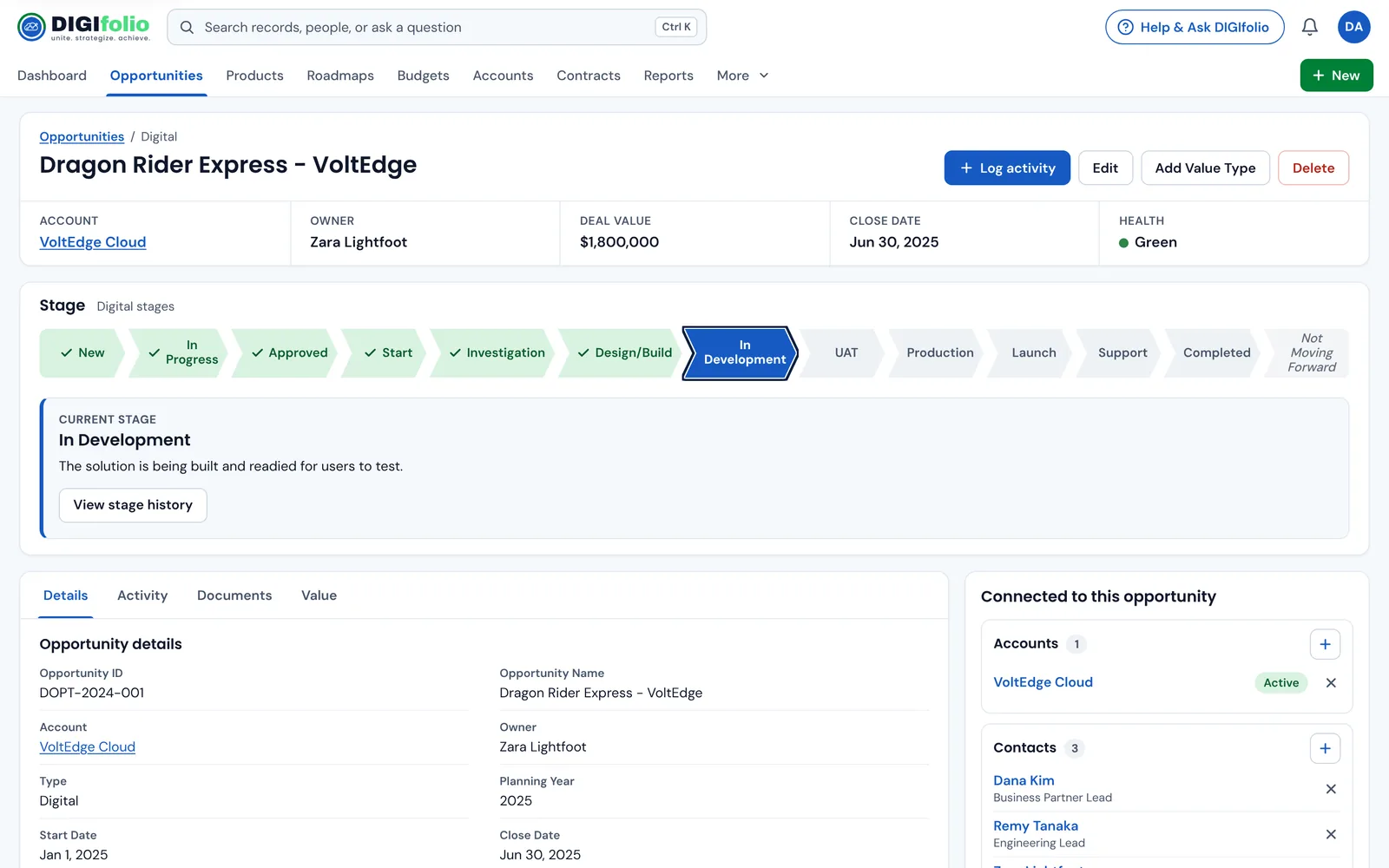
Sales opportunities and internal digital work move differently, so give each its own path. Keep it short enough to remember and specific enough to mean something. For digital work, a path like New, Approved, Investigation, Design/Build, In Development, UAT, Production, Launch, Support, Completed works for most teams. Write one sentence of guidance for each stage so nobody has to guess what it means.
Step 3: Put approvals only where money or risk changes
Mark the two or three stages where funding is committed or production risk is accepted. Those moves go to a manager. Everything else moves freely. Keep a stage history so you can always see who moved what and when.
Step 4: Replace free text with lists
Every free-text field that feeds a report is a future data cleanup. Status, health, priority, category, account type, industry: make them dropdowns, owned by an admin. If a team needs a new value, they ask, and it is added for everyone.
Step 5: Link records instead of copying them
An opportunity should link to its account, contacts, products, roadmap items, budget and contract. It should not copy their names into text fields. Links stay correct when things are renamed. Copies do not.
Step 6: Show people the gaps
Once links exist, missing links become visible. An approved opportunity with no budget. A roadmap item with no feature. A record page that says "this is missing" does more for data quality than any monthly audit.
Step 7: Let dashboards replace status reports
Give every role a ready-made dashboard: pipeline, delivery, budget, contracts, activity, funding and value. Then stop asking for the status report. If the dashboard is wrong, fix the record. That is the habit that keeps data centralized.
Roll it out in thin slices
Do not migrate everything at once. Pick one portfolio, load its catalog and open opportunities, run one monthly review from the dashboards, and fix what feels clumsy. Then add the next portfolio. Most teams can stand up a first slice in an afternoon.
Last in the series: the outcomes you should expect, and how to tell whether it is working.