
Ask ten technology leaders what "centralized data" means and you will get ten answers. Some mean a data warehouse. Some mean a shared drive. Some mean the one spreadsheet that the PMO guards with its life. None of those are wrong, but none of them fix the problem most portfolio teams actually have.
The problem is not that the data lives in many places. The problem is that the same thing is described differently in each place, and nothing connects to anything else.
Centralized means connected, not just collected
Putting every spreadsheet into one folder is collection. It does not make the data any more useful. Centralized portfolio data means three things are true at once:
- Every important thing has one record. A product, an opportunity, a budget, a contract, a roadmap item. One record, one owner, one current state.
- Records point to each other. The opportunity knows which product it is for. The roadmap item knows which feature it delivers and which budget funds it. The contract knows which account it belongs to.
- Everyone uses the same definitions. "In Development" means the same thing in every team, because people pick it from the same list.
When those three things are true, reporting stops being a project. A report is just a question asked of records that already exist.
What lives in a centralized portfolio
For most technology organizations the core records are the same, whatever the industry:
- The product catalog: products, the capabilities they offer, and the features inside each capability.
- Demand: sales opportunities and internal work opportunities, each with a stage, an owner, a value and a date.
- The plan: roadmaps and roadmap items by quarter, with health and status.
- The money: budgets with allocated, spent and remaining amounts, and the value each investment is expected to return.
- The relationships: accounts, contacts, contracts and the activity between you and them.
- The risk: dependencies, with severity, owner and due date.
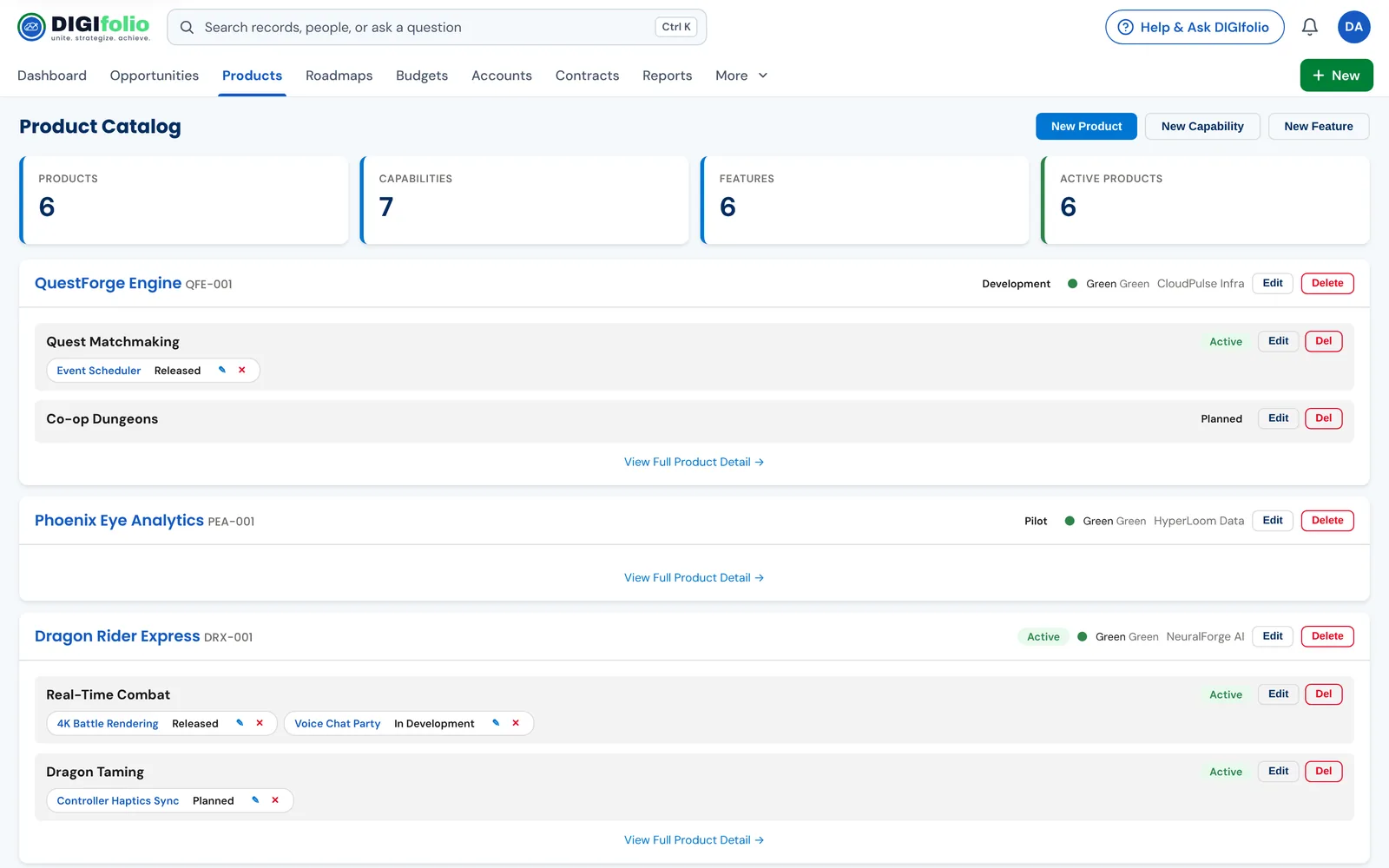
Notice that none of this is exotic. Most organizations already track all of it. They just track it in six tools that do not talk to each other.
What centralized data is not
It is not a reporting layer bolted on top of the mess. Dashboards built on disconnected sources inherit every inconsistency underneath them, then add a delay.
It is not a mandate that everyone abandons their tools on Monday. Engineering will keep its ticket tracker. Finance will keep its ledger. The portfolio record holds the decisions and the links between them, not every ticket and every invoice line.
And it is not a one-time cleanup. Data stays centralized only when updating the central record is the easiest way to do the job. If people have to update the tracker and then also update the portfolio tool, the portfolio tool loses within a quarter.
A simple test
Pick any open opportunity. Can you see, in under a minute, the product it is for, the budget funding it, the roadmap items delivering it and the contract it depends on?
If the answer is yes, your data is centralized. If the answer involves opening three files and messaging two people, it is collected at best.
In the next post in this series we look at why that gap matters so much: what disconnected data actually costs a technology organization, week after week.