

The fastest way to kill a portfolio tool is to make it everyone’s job and therefore nobody’s. Centralizing data only works when each record has an owner and each role knows what it is expected to do.
Four roles cover most organizations
You do not need an elaborate permission matrix. In DIGIfolio we use four roles, and they map well to how real teams work:
- Tenant Admin: owns the workspace. Manages users, roles, settings and, most importantly, the standard dropdown lists everyone picks from.
- Manager: owns the money and the commitments. Budgets, contracts, roadmap priorities, accounts, and approval of stage moves that need sign-off.
- Contributor: owns the work. Products, capabilities, features, opportunities, roadmap items and activities.
- Viewer: consumes. Executives, stakeholders and auditors who need to see everything and change nothing.
Ownership by record, not by tool
The other half of the answer is ownership at the record level. Every opportunity has an owner. Every roadmap item has an owner. Every dependency has an owner. That name is the person who keeps the record true, not the person who does all the work.
A useful rule: if the owner left tomorrow, would someone else know this record is now theirs? If not, ownership is not really assigned.
Who defines the standards
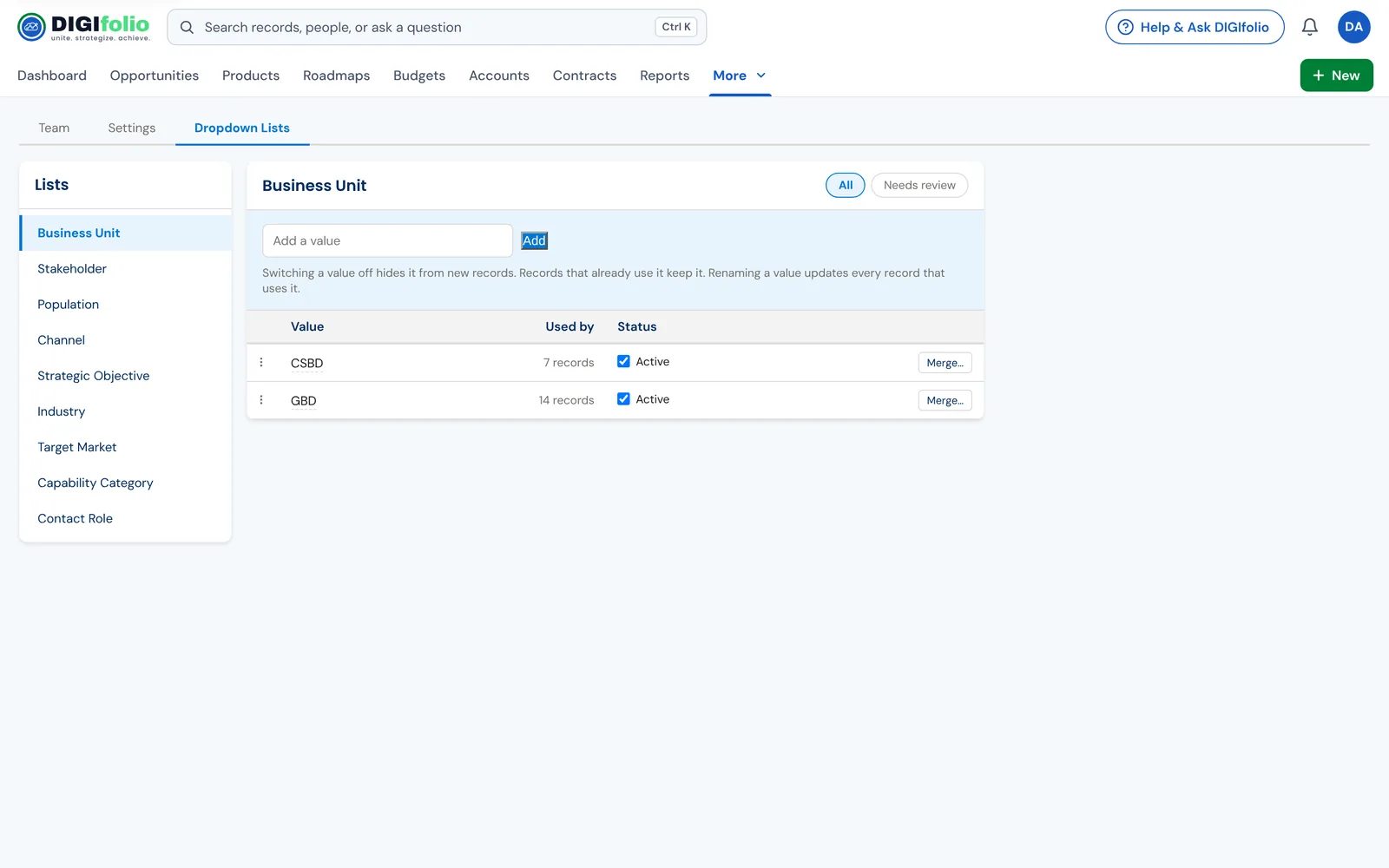
Standard lists (stages, statuses, categories, account types) should be owned by a small group, usually the PMO or the strategy office, and edited by a tenant admin. Teams can ask for a new value. They should not be able to invent one in a free-text box. That single rule does more for reporting quality than any dashboard.
Who approves
Not every stage change needs approval. Most do not. But a few gates matter: moving into funded work, moving into production, closing as not moving forward. Mark those stages as requiring approval and let managers approve or reject with a note. Everything else should flow without friction.
Who reads
Executives should be able to answer their own questions. That means ready-made dashboards for the common questions and a report builder simple enough that a VP will actually use it. If every question still routes through an analyst, the data is centralized but the insight is not.
Next in the series: how to standardize the process itself without turning the portfolio tool into a bureaucracy.